

The Court of Appeal’s landmark decision in Tulip Trading Ltd v van der Laan & Ors [2023] EWCA Civ 83 marks a significant development in digital asset law, addressing whether blockchain developers can be fiduciaries to crypto owners. The case, concerning billions of dollars’ worth of Bitcoin lost in an alleged hack, raises novel questions at the intersection of technology, property, and equity.
This judgment builds upon previous legal recognition of crypto assets as “property” under English law (see AA v Persons Unknown [2019] EWHC 3556 (Comm) ), and forms part of the growing jurisprudence surrounding digital asset recovery, trust obligations, and fiduciary responsibility in decentralised financial ecosystems.
As English courts continue to grapple with the legal status of blockchain participants, the Tulip decision underscores the need for robust legal representation in crypto fraud recovery actions, especially where network governance and asset control intersect.
Background to the Tulip Trading Case: Crypto Ownership and Developer Control
Tulip Trading Limited (“Tulip”), a Seychelles-registered company associated with Dr Craig Wright (who claims to be “Satoshi Nakamoto”), asserted ownership of Bitcoin worth approximately USD 4 billion. The assets were held at two blockchain addresses, but access was lost following an alleged hack that removed the private keys.
Tulip claimed that the core developers of several Bitcoin networks (BTC, BCH, BCH ABC, and BSV) exercised de facto control over the networks and were capable of deploying a software patch to restore its access. Tulip therefore argued that the developers owed fiduciary and tortious duties to act in good faith to assist the true owner of the digital property.
The developers, all based outside England, denied any such duty arguing that blockchain governance is decentralised, that developers act voluntarily and collaboratively, and that imposing fiduciary duties would be unworkable.
The High Court (Falk J, [2022] EWHC 667 (Ch)) held that no realistic prospect existed of establishing a fiduciary relationship. However, the Court of Appeal overturned that finding ruling that Tulip had raised a serious issue to be tried.
Check Your Litigation Case ✔
We analyse your case prospects. We deliver strategic legal advice at your first fixed fee meeting. We get optimal legal results. Want our opinion on your case? Click below or call our lawyers in London on ☎ 02071830529
View The PDF Judgment here:
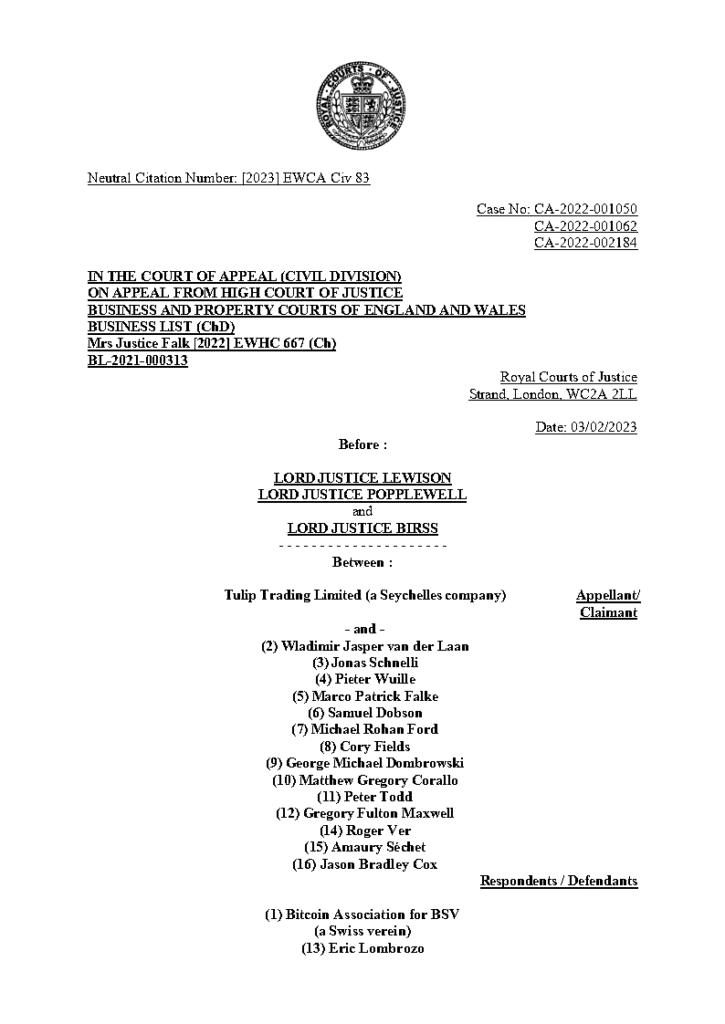
Court of Appeal Recognises Possible Fiduciary Duty of Bitcoin Developers
1. Fiduciary Duty May Extend to Blockchain Developers
Lord Justice Birss (with Popplewell and Lewison LJJ agreeing) held that it is arguable that developers, by controlling access to and modification of blockchain software, exercise discretionary powers affecting others’ property interests potentially giving rise to fiduciary obligations.
At [70]–[76], Birss LJ reasoned that:
“The developers are people who have undertaken a role which at least bears some relationship to the interests of other people… in relation to property owned by those other people.”
This potential duty includes a duty of single-minded loyalty and an obligation not to act in their own self-interest to the detriment of asset owners.
2. “Entrustment” and Control as Fiduciary Indicators
Although crypto is decentralised in theory, the Court accepted that developers may have de facto control because only they can alter the source code governing asset ownership and transfer. As Birss LJ observed ([78]):
“In a very real sense the owners of bitcoin… have placed their property into the care of the developers. That is, in my judgment, arguably an ‘entrustment.’”
3. Duty to Act Positively in Certain Circumstances
Tulip alleged that once ownership is judicially confirmed, developers must act to safeguard the true owner’s assets (e.g., by issuing a patch transferring or freezing stolen coins). The Court accepted that a positive fiduciary obligation to introduce code changes was arguable, given developers’ unique authority.
4. Decentralisation Not a Bar at Pleading Stage
The defendants’ reliance on “decentralisation” as a defence was rejected at this early stage. Whether blockchain governance is genuinely decentralised is a factual issue unsuitable for summary determination.
5. Recognition of Property Rights in Crypto assets
Reaffirming AA v Persons Unknown, the Court confirmed that cryptocurrencies constitute property under English law, capable of ownership, control, and equitable protection.
Legal Implications for Blockchain Governance and Cryptoasset Law
The ruling does not establish that developers do owe fiduciary duties but it firmly opens the door to such claims. English law continues to evolve to address decentralised governance and property protection in crypto networks.
If, after trial, such duties are recognised, the implications could be profound:
- Developers’ exposure: Core maintainers may face claims where network code changes (or omissions) affect asset holders.
- Asset recovery mechanisms: Victims of crypto theft may have new equitable remedies, supplementing tracing and proprietary injunctions.
- Regulatory influence: Courts may increasingly treat blockchain governance roles akin to trustees or custodians, particularly where economic reliance exists.
- Common law evolution: The case aligns with the Law Commission’s work on digital assets and could shape statutory reform to clarify fiduciary and tortious responsibilities in decentralised systems.
As Birss LJ remarked: “If the decentralised governance of bitcoin really is a myth, then… bitcoin developers, while acting as developers, owe fiduciary duties to the true owners of that property.”
Defending Fiduciary Duty Claims Against Developers: How LexLaw Can Help
For individuals or companies accused of fiduciary breaches whether as directors, trustees, or blockchain developers strategic defence is crucial. LexLaw Solicitors, experienced in high-value fiduciary and trust litigation, can:
- Conduct forensic analysis of network governance and control structures to dispute alleged “entrustment.”
- Argue that decentralisation negates control and thus fiduciary capacity.
- Demonstrate that positive duties to act are inconsistent with established fiduciary principles.
- Obtain protective declarations and indemnities to mitigate exposure during ongoing network management.
As demonstrated in our successful defence of director misfeasance and trust claims, prompt legal advice can prevent adverse findings and limit cross-border enforcement risks.
Check Your Litigation Case ✔
We analyse your case prospects. We deliver strategic legal advice at your first fixed fee meeting. We get optimal legal results. Want our opinion on your case? Click below or call our lawyers in London on ☎ 02071830529
Frequently Asked Questions
What is a fiduciary duty under English law?
A fiduciary owes loyalty and good faith to another, acting solely in that person’s interests. This includes duties to avoid conflicts, act honestly, and not profit from one’s position.
How can developers be fiduciaries?
Where developers exercise exclusive control over code affecting property, courts may treat their role as analogous to trustees or agents creating fiduciary obligations.
Does the Tulip Trading case mean developers are liable?
Not yet. The Court of Appeal only found that there is a serious issue to be tried. Liability will depend on trial findings about control and decentralisation.
What if blockchain governance is decentralised?
If developers act as part of an open, unstructured collective without central authority, fiduciary duties may not arise. This factual issue remains central to the Tulip trial.
Can crypto be treated as “property” in the UK?
Yes. Following AA v Persons Unknown, cryptocurrencies are recognised as property under the National Provincial Bank v Ainsworth test.
Can LexLaw assist with crypto fiduciary disputes?
Yes. Our litigation team advises on fiduciary, fraud, and trust-related blockchain disputes, representing clients in the High Court and Court of Appeal.