

This judgment in London International Exhibition Centre plc v Allianz Insurance plc & Ors [2024] EWCA Civ 1026 significantly clarifies the scope of business interruption (“BI”) insurance claims relating to COVID-19 where cover depends on disease “at the premises”. It builds upon the Supreme Court’s approach in the FCA Test Case (Financial Conduct Authority v Arch Insurance (UK) Ltd [2021] AC 649) by confirming that concurrent causation applies equally to at-the-premises wordings. The Court rejected insurers’ arguments that policyholders must show the government specifically knew about and responded to COVID-19 cases at each individual premises. The ruling has substantial implications for SMEs pursuing pandemic-related BI losses, and also informs broader disputes on disease cover, causation, and insurance recovery strategies. This decision reinforces the importance of early legal advice from specialist litigation solicitors, such as those at LexLaw, particularly where insurers maintain narrow or technical policy interpretations in complex claims.
Check Your Litigation Case ✔
We analyse your case prospects. We deliver strategic legal advice at your first fixed fee meeting. We get optimal legal results. Want our opinion on your case? Click below or call our lawyers in London on ☎ 02071830529
Case Background: COVID-19 BI Claims and the “At-the-Premises” Dispute
The judgment concerned six expedited test cases, including the claim brought by London International Exhibition Centre plc (“ExCeL London”), seeking indemnity for business interruption losses caused by national COVID-19 closure measures. Although each insurer used slightly different BI wordings, all relevant clauses provided cover for infectious disease occurring “at the premises” of the policyholder.
The High Court previously ruled that policyholders needed only to prove one case of COVID-19 at the insured premises prior to closure, and that this case formed part of the concurrent cause of the government’s decision to impose lockdown. Insurers appealed, arguing that the “at the premises” wording required direct causation, including actual governmental knowledge of the specific case at the insured premises.
The Court of Appeal rejected all insurer arguments and upheld the High Court’s findings.
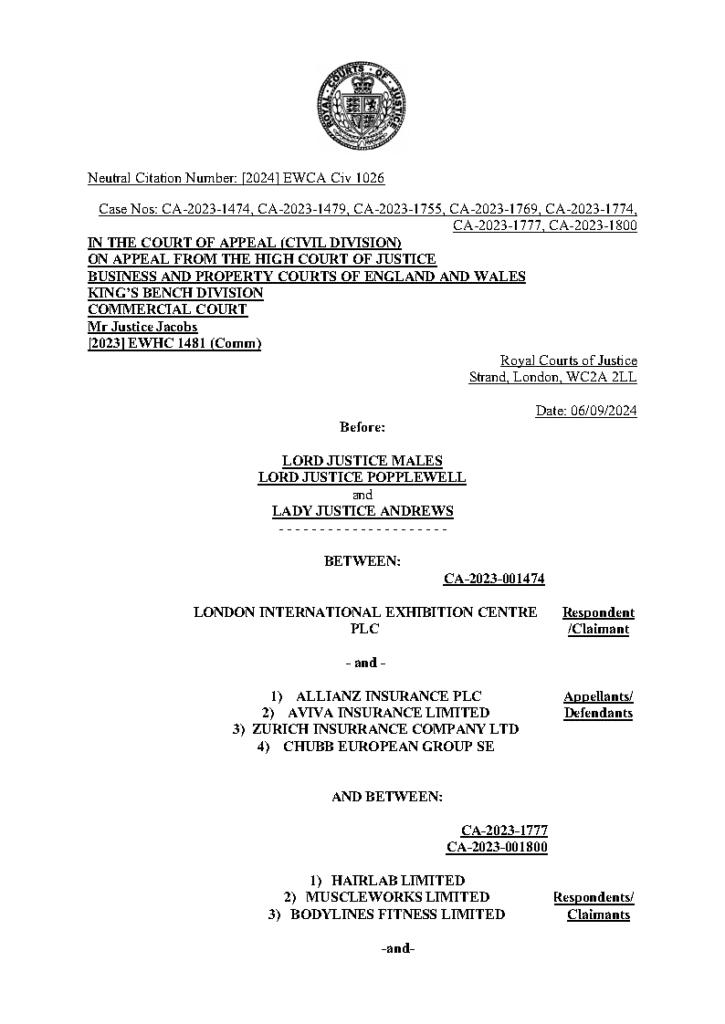
View The PDF Judgment Below:
Key Findings in London International Exhibition Centre plc v Allianz
Concurrent Causation Applies to At-the-Premises Disease Clauses
The Court of Appeal held that the logic of the Supreme Court in FCA v Arch applies equally to “at-the-premises” wording. Each case of COVID-19 across the UK was a concurrent and equally effective cause of national government intervention. Thus, even a single occurrence of the disease at the insured premises satisfied the causation requirement.
At paragraph [176], the Court noted:
“There is no reason in principle why the Supreme Court’s analysis of multiple concurrent causes should not apply to at-the-premises disease wordings.”
The reasoning reflects policyholder expectations: national measures were imposed in response to the epidemic as a whole, and each individual case formed part of that causal mosaic.
No Requirement for Government Knowledge of the Case at the Premises
Insurers argued that the government must have known about and acted upon the specific occurrence of disease at the premises. The Court dismissed this argument. There is no wording requiring proof that authorities knew about the case, nor that they acted because of that specific case.
At paragraph [250], the Court confirmed:
“The requirement for reporting and knowledge was… part and parcel of the causation arguments… since those arguments are rejected, the knowledge requirement is also rejected.”
“At the Premises” Is Not Materially Different from a Radius Clause
Insurers attempted to distinguish radius-based cover from at-the-premises cover. The Court disagreed, noting that both clauses merely identify the geographical location of the insured peril; they do not alter the nature of causation.
At paragraph [202], the Court held that the radius in the FCA Test Case could be as small as 10 metres, rendering it functionally similar to an “at the premises” boundary.
No But-For Test and No “Distinct Effective Cause” Requirement
The Court rejected insurers’ efforts to impose a stricter “but-for” or “distinct effective cause” test. Such approaches contradicted the Supreme Court’s position that a loss may be caused by multiple sufficient causes acting concurrently.
At paragraph [194], the Court reaffirmed that business interruption clauses must be interpreted in a commercially sensible manner consistent with how SME policyholders would understand them.
Implications of the Judgment for Policyholders and Insurers
This judgment is one of the most significant appellate decisions since the FCA Test Case. It confirms that policyholders with “at-the-premises” disease wordings need only prove:
• At least one case of COVID-19 occurred at the premises before closure.
• That national measures were taken in response to the pandemic as a whole.
This interpretation prevents insurers from avoiding liability through narrow or technical interpretations of causation. The Court’s focus on commercial expectations and policyholder fairness underscores the judiciary’s continued scrutiny of insurer behaviour during the pandemic.
The reasoning also strengthens policyholders’ positions in other disputes involving concurrent causation, disease cover, and hybrid BI extensions. It reduces the evidential burden on SMEs, many of whom were unable to obtain detailed contact-tracing data in early 2020. The Court’s insistence that cover does not depend on governmental knowledge prevents the arbitrary exclusion of claims simply because early cases were under-reported.
This ruling therefore has enduring importance for BI litigation strategy, especially where insurers seek to resist claims by relying on technical distinctions between disease occurrences, notification requirements, or levels of governmental awareness.
Defending Director Claims and Complex Insurance Disputes
Businesses facing insurer resistance in BI claims or other disputes benefit from early forensic analysis and expert legal representation. Specialist solicitors routinely utilise epidemiological evidence, policy construction arguments, and financial reconstruction of loss periods to challenge insurer positions.
LexLaw’s litigation team is regularly instructed in high-value insurance disputes, wrongful trading claims, and funded recovery actions. Drawing on experience from directors’ duties litigation, and complex financial investigations, the firm assists clients in presenting robust evidence on causation, loss quantification, and policy interpretation.
As demonstrated in LexLaw’s successful defence of wrongful trading and misfeasance claims, timely strategic advice is critical when facing aggressive insurer tactics or litigation funder-backed claims. The London International Exhibition Centre judgment reinforces the importance of specialist input when analysing complex concurrent causation issues and contractual wording disputes.
Check Your Litigation Case ✔
We analyse your case prospects. We deliver strategic legal advice at your first fixed fee meeting. We get optimal legal results. Want our opinion on your case? Click below or call our lawyers in London on ☎ 02071830529
Frequently Asked Questions (FAQ’s)
Can a single case of COVID-19 at the premises trigger BI cover?
Yes. The Court held that one case is enough, as it forms part of the concurrent cause of national restrictions. Policyholders do not need to show that the case materially influenced government decisions.
Did the government need to know about the specific case at the premises?
No. The Court rejected any requirement for governmental knowledge or reporting. What matters is that the case existed and occurred before the closure measures.
Does this ruling apply only to large venues like ExCeL London?
No. The test cases included small restaurants, gyms, nightclubs, and bars. The ruling protects SMEs across the UK with “disease at the premises” BI cover.
Can insurers argue that cases at other locations were the real cause of closure?
No. The Court confirmed that all cases nationwide were concurrent causes. Insurers cannot rely on external cases to defeat cover within the premises.
Does the case affect hybrid disease/prevention-of-access clauses?
Yes. The reasoning aligns closely with FCA v Arch, ensuring consistent application of concurrent causation principles.
Can policyholders still bring claims if insurers previously rejected them?
Yes. Many denied claims can now be revisited, and LexLaw can assist in re-opening or challenging prior decisions.
How does this ruling affect ongoing BI coverage disputes?
It significantly strengthens policyholder positions and undermines insurer reliance on narrow causation arguments.