

This High Court judgment (Manolete Partners Plc v Sampson Coward LLP [2023] EWHC 37 (Ch)) underscores the growing liability risks faced by solicitors acting as escrow agents in insolvency contexts. The case, driven by litigation funder Manolete Partners, involved allegations of breach of undertakings and fiduciary failings. Deputy Master Teverson’s decision affirms that factual disputes over beneficial ownership and undertakings enforcement against LLPs require full trials, not early dismissal. It also highlights how assigned claims in insolvency can pursue solicitors and other professionals directly for mismanagement of client funds. The case reinforces the importance of clear escrow arrangements, timely compliance with professional duties, and understanding the potential personal consequences of pre-liquidation conduct. For solicitors and directors facing similar risks, immediate legal advice from LEXLAW’s specialist insolvency solicitors is essential.
Case Background
Two development companies, UK Property & Land Specialists Ltd and Nero Developments Ltd borrowed funds from third-party lenders. A law firm was appointed to manage funds through escrow arrangements and security account transactions totalling nearly £10 million. However, after the companies entered insolvency, administrators discovered discrepancies in fund handling.
Manolete Partners acquired the companies’ claims and alleged that over £2 million had been wrongly paid out from escrow, in breach of written undertakings and without borrower authorisation. The claimant also alleged that the law firm facilitated “back-to-back” property sales at under-market value, improperly benefitting third parties. The claim raised concerns not only of breach of retainer and fiduciary duty but of whether solicitors had improperly allowed client account misuse.
The law firm applied for summary judgment, arguing the borrowers had no legal entitlement to the funds and that any undertakings were non-enforceable under existing Supreme Court authority.
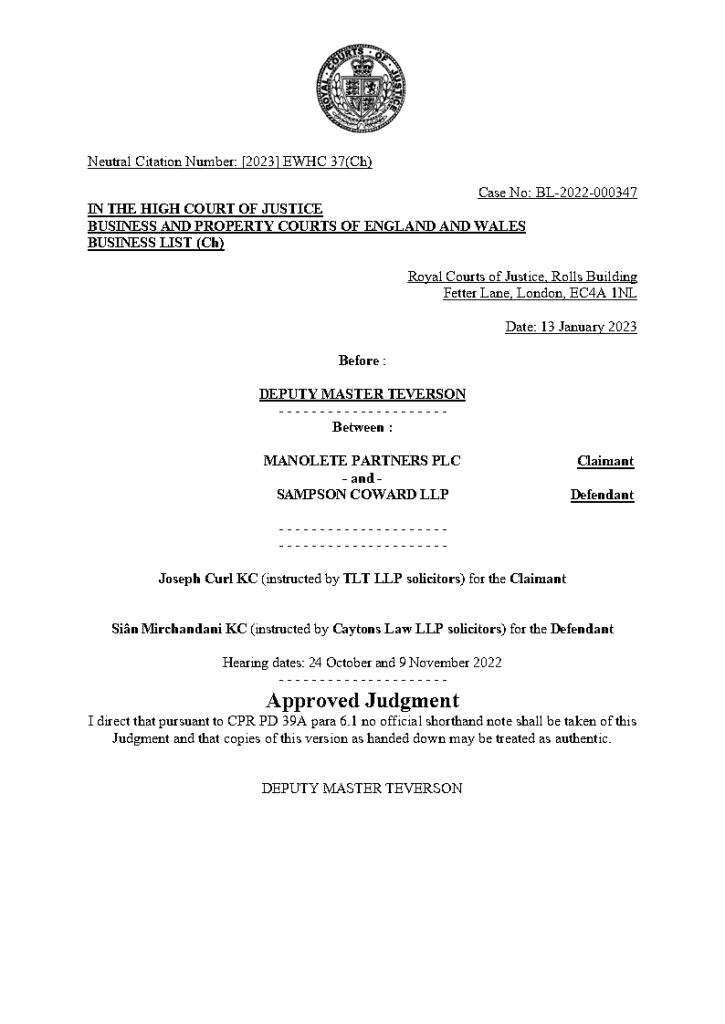
View the PDF Judgment Below:
Key Findings in Manolete v Sampson Coward
Summary Dismissal Rejected – Factual Issues Must Be Tried
Deputy Master Teverson firmly rejected the application, finding serious triable issues across all key heads of claim. The court stated:
“The existence of a beneficial interest, even if merely an equitable entitlement to assert control over application of funds, raises sufficient uncertainty to render summary disposal inappropriate.”
Solicitor Undertakings by LLPs Still Subject to Evolving Law
Sampson Coward relied on Harcus Sinclair LLP v Your Lawyers Ltd [2021] UKSC 32 to argue undertakings were unenforceable against LLPs. However, the judge noted:
“While the Supreme Court recognised limitations, it did not wholly foreclose the possibility that the inherent jurisdiction may evolve to permit enforcement in appropriate circumstances. This is not a settled issue.”
Back-to-Back Sales Allegations Not Suitable for Early Strike-Out
Allegations around connected transactions and causation were not sufficiently resolved on the pleadings. Deputy Master Teverson explained:
“Where causation depends on facts in the exclusive knowledge of the defendants, the court must be cautious about granting summary judgment before disclosure.”
Implications of Manolete v Sampson Coward
This judgment reflects an important judicial willingness to examine the professional conduct of solicitors involved in complex pre-insolvency financial arrangements. Where litigation funders such as Manolete acquire claims, they bring to court well-resourced, focused litigation strategies that target historical wrongdoing, often extending beyond directors to third-party advisors.
The court’s openness to evolving undertakings enforcement suggests LLP structures will not immunise professionals from scrutiny, especially where escrow arrangements or fiduciary breaches are involved. The refusal to strike out causation arguments at an early stage also affirms the court’s commitment to full fact-finding where allegations involve financial complexity and interlinked transactions.
Solicitors and professionals dealing with client funds in insolvency-affected transactions must ensure clear authorisation trails and accurate record-keeping. Even seemingly technical breaches can give rise to significant personal exposure when viewed through the lens of litigation-funder-driven claims.
Defending Manolete Director Claims
Responding to claims funded by Manolete requires strategic, evidence-based defence tactics. Where funds are alleged to have been misused, forensic accounting and expert analysis can be crucial in identifying gaps in the claimant’s narrative. Solicitors defending such claims should secure contemporaneous communications and instructions evidencing compliance with client mandates. At such instances, it is crucial to secure solicitors who bear expertise in such claims.
Undertakings enforcement remains a fluid area. Legal submissions can explore the boundaries of the Supreme Court’s findings in Harcus Sinclair, emphasising that equitable remedies should not be applied retroactively where clear procedural injustice may result.
In our defence of professional negligence and insolvency claims, early challenge to causation and beneficial interest assumptions can shift the litigation focus. Structured mediation or ADR may also expose weaknesses in a funder’s case, enhancing settlement positioning. Our team frequently represents professionals and directors in high-value insolvency claims pursued by assignees like Manolete.
Instruct Expert London Litigation Lawyers
This case confirms the courts’ continued willingness to scrutinise professional conduct, especially in insolvency contexts where litigation funders like Manolete Partners are actively pursuing recovery on behalf of distressed estates. The refusal of summary judgment sends a clear message: claims involving escrow misuse, undertakings, and connected transactions will not be easily dismissed, particularly where factual disputes persist. Solicitors and other fiduciaries acting near insolvency events must take proactive legal advice to mitigate the risk of exposure. At LEXLAW, our insolvency litigation team has substantial experience defending complex claims arising from assigned causes of action. We provide practical, trial-ready strategies to challenge both the legal and factual foundations of such proceedings, securing favourable settlements and full dismissals. If you are facing a claim from Manolete or any litigation funder, contact LEXLAW’s expert defence solicitors for strategic advice without delay.
Check Your Litigation Case ✔
We analyse your case prospects. We deliver strategic legal advice at your first fixed fee meeting. We get optimal legal results. Want our opinion on your case? Click below or call our lawyers in London on ☎ 02071830529