

The judgment in Manolete Partners Plc v Dalal [2023] EWCA Civ 269 is a significant authority on the evidential threshold required in director misfeasance and additional sales receipt claims, especially where the claim is based on HMRC assessments and business economics exercises. For directors facing similar claims, this ruling demonstrates the importance of robustly contesting the factual basis of liquidator and funder-driven claims, as detailed in our legal guide to defending Manolete claims.
The case, funded by Manolete Partners, highlights the difficulties in proving unreported sales where company records are incomplete and HMRC’s methodology is open to challenge. The judgment also provides guidance on the application of the civil standard of proof in insolvency litigation, reinforcing principles from the Insolvency Act 1986 and recent case law on directors’ duties and misfeasance actions.
For further context on directors’ duties and insolvency claims, see our directors’ duties claims resource and our analysis of winding-up petition defences.
We are the leading UK firm defending directors against Manolete Partners’ claims due to our expertise in insolvency litigation and strategic defence tactics. Our dual-qualified and experienced solicitors & barristers, based near London’s Royal Courts of Justice, specialise in countering Manolete’s aggressive pursuit of transactions-at-undervalue claims e.g. by challenging evidence validity, leveraging limitation periods, and demonstrating good faith per the Insolvency Act 1986. We have a track record of protecting directors’ assets, including family homes, while navigating complex financial and regulatory risks. Our insolvency law focus and experience with litigation funders ensures tailored, robust defence in high-stakes claims. Get in touch about your Director’s Duties case.
Manolete Partners Plc v Dalal
The claim arose from the insolvency of a poultry processing company, with Manolete Partners taking assignment of the liquidator’s cause of action against Mr Ebrahim Dalal, the company’s former director. The liquidator, relying on HMRC’s tax assessments and a Business Economics Exercise (BEE), alleged that the company had systematically underreported sales between incorporation and 30 September 2014, resulting in an alleged shortfall of £849,278 in turnover and £61,249 in gross profit. The claim was that these missing receipts were explained by withdrawals from Mr Dalal’s director’s loan account.
Mr Dalal, aged 84 and residing in India, gave evidence via interpreter, explaining his limited English literacy and reliance on accountants for company filings. The company’s record-keeping was acknowledged to be imperfect, with both HMRC and independent accountants noting deficiencies. However, the physical company records for much of the relevant period had been destroyed by HMRC, and the trial bundle contained only a small sample of sales documents.
The High Court, and subsequently the Court of Appeal, were tasked with determining whether the evidence-largely reconstructed from HMRC’s BEE and a handful of invoices-was sufficient to prove, on the balance of probabilities, that there had been significant unreported sales justifying recovery from Mr. Dalal.
Court’s Findings in Manolete Partners Plc v Dalal
Evidential Burden and Assessment
The Court of Appeal emphasised that the civil standard of proof requires the claimant to show that their case is more likely than not, applying a rational and objective assessment of all evidence. Lord Justice Arnold noted: “The judge accepted that the Company’s record keeping had been less than perfect, and that it was therefore possible that sales had been underdeclared. He went on to make findings based on the evidence that was available” (para 22). The judge’s approach was to analyse available data, including quantities of chickens slaughtered, sale prices, and wastage, to estimate total sales for 2009 at around £2.6 million-slightly less than reported in the accounts (para 23).
The court rejected Manolete’s argument that even a 1% discrepancy would prove additional sales, describing this as “obviously wrong” (para 24). The evidence was “very thin” and the sampling of invoices represented only 0.25% of sales, limiting reliability (para 21). The judge’s conclusion that Manolete had not proved additional sales was therefore upheld.
Director’s Reliance on Accountants
Mr Dalal’s evidence that he relied on professional accountants for tax and record-keeping was accepted as plausible and consistent with the realities of company management (para 20). There was no suggestion of deliberate concealment or failure to disclose relevant documents.
Record-Keeping Deficiencies
While acknowledging poor record-keeping, the court held that this alone did not establish misappropriation or additional sales receipts (para 22). The claim failed on the strength of the evidence, not merely on documentary gaps.
Critique of HMRC’s Methodology
The judge was particularly critical of the reliance on a small sample of invoices:
“If HMRC’s method 2 was the only evidence as to average selling price, he would have regarded it as too unreliable to base any conclusions on. It was based on a sample of 0.25% of the Company’s sales in that year, which could not be taken to be a reliable method for determining the average sale price.” (para 170)
Instead, the judge used the “best evidence available”-a larger sample of invoices from later years-but still found the discrepancy between estimated and reported sales (12%) was within the margin of error and insufficient to justify a finding of unreported sales.
Implications of Manolete Partners Plc v Dalal
This case is a landmark for directors facing claims funded by Manolete or other litigation funders, particularly where the claim is constructed on reconstructed accounts or HMRC assessments rather than primary evidence. The courts have made clear that:
- Technical deficiencies in record-keeping, while problematic, do not automatically translate into liability for unreported sales unless the evidence is cogent and the discrepancy is significant.
- The burden remains on claimants (liquidators or their assignees) to prove their case on the balance of probabilities, with courts unwilling to infer wrongdoing from weak or speculative evidence.
- The decision confirms that courts will scrutinise the methodology behind HMRC assessments and will not simply accept their conclusions if based on small or unrepresentative samples.
- For directors, especially those with limited involvement in company administration or language barriers, the courts will consider the practicalities of their role and reliance on professional advisers.
- The judgment provides a robust precedent for resisting claims where the evidence is “thin” or where the margin of error in reconstructed accounts is substantial.
For more detailed guidance on defending such claims, see our legal guide to defending Manolete claims.
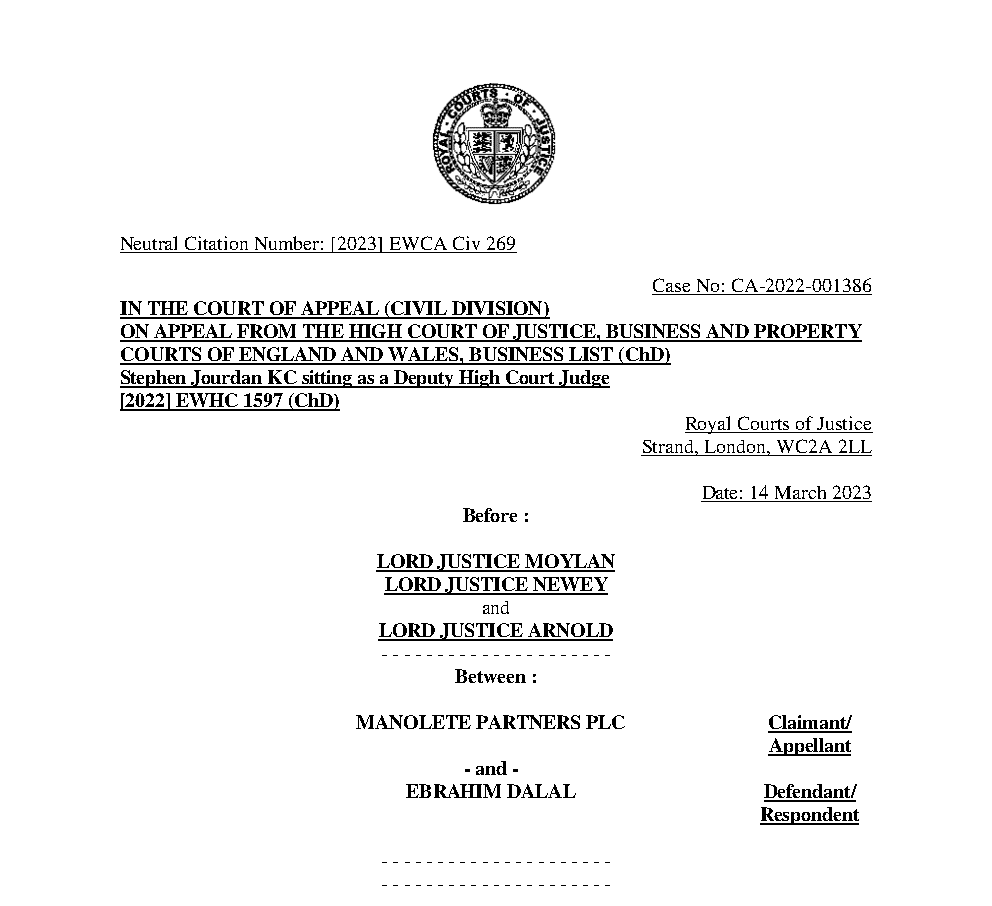
Download The Judgment here:
Defending Manolete Director Claims
Directors facing claims from liquidators or Manolete Partners should take a strategic, evidence-led approach. Early forensic review of the claimant’s methodology is vital-challenging the reliability of reconstructed sales figures and the representativeness of any sample used. Where company records are incomplete, directors should document the reasons (e.g., reliance on accountants, records lost or destroyed) and seek to obtain alternative evidence (such as customer or supplier records) to corroborate reported figures.
Expert forensic accountants can be instrumental in exposing flaws in the claimant’s calculations, particularly where HMRC’s methods are based on assumptions or limited data. Directors should also ensure that any allegations regarding director’s loan accounts or personal withdrawals are properly contextualized and supported by contemporaneous evidence.
Engaging experienced insolvency dispute solicitors early can help manage disclosure obligations and avoid adverse inferences. As demonstrated in this case, courts will not penalize directors solely for imperfect record-keeping if the claimant cannot prove its case to the required standard.
For further tactical advice, our team can assist with robust, evidence-based defences to Manolete-funded claims.
Expert Legal Representation against Claims Brought By Manolete Partners
Our expert team is highly experienced in defending claims brought by litigation funders such as Manolete Partners. With a deep understanding of the complex nature of litigation funding, we offer strategic, robust legal support to protect your interests. Our solicitors have a proven track record of successfully challenging claims in insolvency and other contentious matters, providing you with tailored solutions to navigate the pressures and complexities of litigation. Whether you are facing legal action from Manolete or another litigation funder, we will work closely with you to develop a strong defence and achieve the best possible outcome for your case.
FAQs on Director’s Duties and Insolvency Claims
Can a director be liable for unreported sales if company records are incomplete?
Not automatically. As shown in Manolete Partners Plc v Dalal, the claimant must still prove, on the balance of probabilities, that sales were actually unreported, not merely that records were deficient. Courts require cogent evidence, not speculation.
What is the burden of proof in director misfeasance or additional sales claims?
The claimant must prove its case on the civil balance of probabilities. The court will only decide on the burden of proof where the evidence is so unsatisfactory that no other conclusion is possible, as explained in Re A (Children) and applied in this case.
Does reliance on accountants protect directors from liability?
It can be a significant factor. The court accepted Mr Dalal’s evidence that he relied on his accountant due to language barriers and lack of administrative expertise, finding this plausible and relevant to the assessment of his conduct. For more on director reliance defences, see our directors’ duties resource.
Can Manolete pursue claims based solely on HMRC assessments?
They can, but as this case demonstrates, such claims may fail if the underlying evidence is weak or the methodology is flawed. Directors should instruct solicitors familiar with defending Manolete claims to challenge the evidential basis robustly.
Are directors personally at risk for company tax understatements?
Only if it can be shown that they deliberately or negligently caused the understatement and personally benefited. The evidential burden remains with the claimant, as discussed in our tax disputes insolvency guide.
How does Manolete’s funding model affect settlement negotiations?
Manolete’s commercial approach may lead to aggressive settlement tactics, but as this case shows, weak claims can be successfully defended if the evidence is challenged effectively. For negotiation strategies, see our guide to defending Manolete claims.
Why is this case significant for insolvency law?
This case clarifies the evidential standards required to prove director liability, particularly where claims depend on economic modelling and partial records. It reinforces the courts’ insistence on robust, reliable evidence and proper application of the civil standard of proof.
Check Your Litigation Case ✔
We analyse your case prospects. We deliver strategic legal advice at your first fixed fee meeting. We get optimal legal results. Want our opinion on your case? Click below or call our lawyers in London on ☎ 02071830529