

This judgment (Re BSS LED [R&D] Ltd [2024] EWHC 1636 (Ch)) reinforces directors’ obligations under section 172 of the Companies Act 2006 to prioritise creditor interests when insolvency is probable. The ruling, pursued by litigation funder Manolete Partners, illustrates the risks directors face where assets are diverted to connected entities, contrary to sections 238–239 of the Insolvency Act 1986. As seen in similar directors’ duties claims, courts will not hesitate to impose personal liability for misapplied funds. Businesses facing financial distress should seek urgent advice on winding-up petitions or restructuring to mitigate exposure. This case demonstrates how Manolete utilises its funding model to pursue aggressive recovery actions against directors. Expert legal guidance at this critical juncture is absolutely necessary.
Case Background
BSS LED [R&D] Limited was incorporated in 2010 as Building Software Solutions Ltd and later rebranded to focus on LED lighting. Initially, the company traded by importing lighting products from China, but quality issues led it to shift towards manufacturing in the UK. To support this, the business relocated to Northumberland in 2014, benefitting from a Regional Growth Fund grant. However, the location proved commercially disadvantageous due to poor accessibility and limited workforce availability. By 2017, the business returned to Manchester in an attempt to stabilise operations, though production inefficiencies cost an estimated £250,000.
Despite these efforts, BSS faced sustained financial pressure. The company relied heavily on a factoring facility with Lloyds Bank, which was terminated in 2018 after disputes regarding cash allocations. This termination critically impaired cash flow, and by 2019 the company ceased trading, transferring employees and stock to a related entity, BSS LED Manufacturing Ltd. When liquidation followed in November 2019, a deficiency of £961,532 was recorded in the statement of affairs.
The liquidator, Ms Claire Dwyer, later assigned claims against the director and related companies to Manolete Partners in January 2021. The claims covered breaches of fiduciary duty, asset transfers at undervalue, preferences under sections 238 and 239 Insolvency Act 1986, and unjust enrichment. Manolete initiated proceedings against Mr Steven Bell, his sons, and connected companies, although the case ultimately proceeded only against Mr Bell. The trial was heard before ICC Judge Mullen in March 2024, with judgment delivered in June 2024.
Read the Judgment Below:
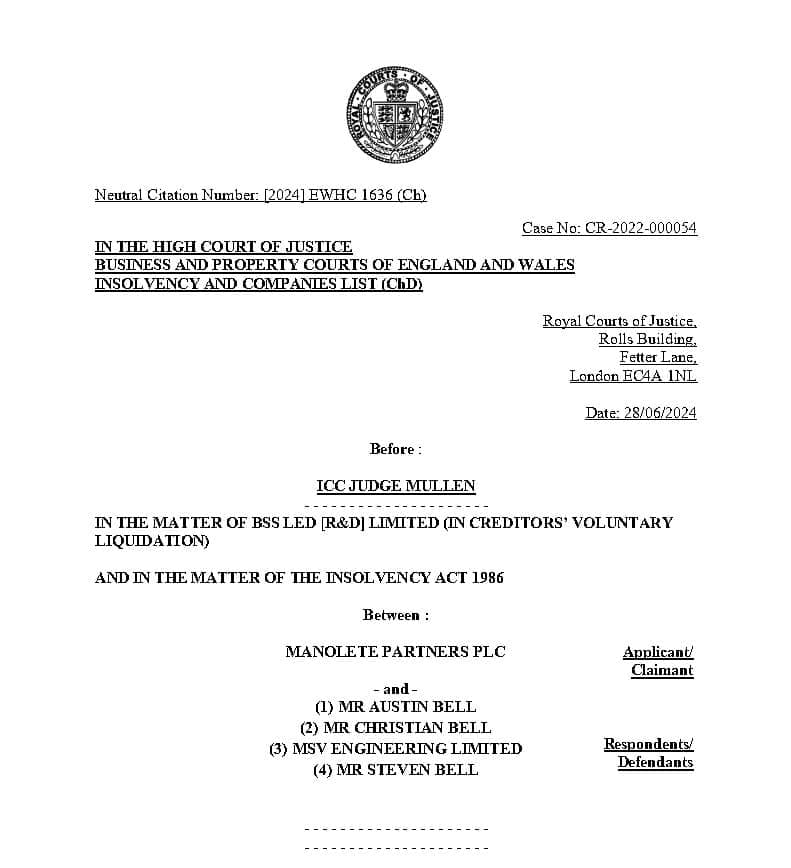
Key Findings in Re BSS LED [R&D] Ltd [2024]
Insolvency Established Early
ICC Judge Mullen held that BSS was insolvent by April 2018. The Court dismissed Mr Bell’s explanations that non-payment of rent and supplier invoices was “strategic,” instead finding:
“The contemporaneous documents are consistent with a company that was struggling financially and trying to meet its rent obligations until it was unable to do so” (para 42).
This finding was central, as directors’ duties shift towards creditors once insolvency is probable.
Sale of Equipment at Undervalue
In July 2018, BSS sold equipment to MSV Engineering Ltd for £55,000. Evidence in a subsequent lease valued the equipment at approximately £120,000. Judge Mullen concluded:
“I am satisfied that the equipment had a value of at least £120,000… On balance, I am satisfied that the equipment was disposed of at an undervalue of £65,000” (para 64).
This illustrated both a breach of fiduciary duty and a transaction at undervalue under s.238 Insolvency Act 1986.
Transfers to Connected Companies
Between October 2018 and June 2019, BSS transferred over £143,000 to BSS LED Manufacturing Ltd. Mr Bell claimed these were reimbursements, but the Court disagreed:
“The only inference that I can draw is that they represented an attempt to transfer monies out of BSS and into the company that was to carry on the business formerly carried on by BSS” (para 68).
The Court held these were either preferences or misfeasance, rendering Mr Bell personally liable.
Stock and Office Equipment Transfers
The company transferred stock and office equipment worth £138,680 to Manufacturing without payment. Mr Bell argued this was part of contra transactions, but the Court found no evidence of offsetting liabilities. Judge Mullen concluded this was another attempt to strip assets:
“It was a breach of Mr Bell’s duty to consider the interests of creditors not to secure payment for the transfer… In the event the company ended up with neither the equipment nor the purchase monies” (para 69).
Improper Personal Payments
Mr Bell extracted nearly £100,000 from BSS between April and November 2018, with only partial repayments. The balance left him owing £50,712.24. He claimed these were dividends and salary, but the Court found no contractual entitlement to remuneration. Judge Mullen stated:
“I am satisfied that there was no entitlement and the payments were made to Mr Bell in breach of duty” (para 73).
Family and Personal Benefits
Additional liabilities included tuition fees of £3,145 for Mr Bell’s son, Austin, paid after his employment had transferred to another entity. Judge Mullen categorised this as an illegitimate “loading of expenses onto the insolvent company” (para 80). Similarly, unrecovered laptops, iPhones, and international travel expenses were deemed misuses of company funds.
Implications of the Case
The ruling underscores the strict approach courts adopt in director misfeasance claims. Once insolvency looms, directors must actively prioritise creditors’ interests. The decision affirms that transactions at undervalue and preferences to connected companies will be unwound, and directors personally liable for resulting losses. Furthermore, it underpins the need to obtain timely legal advice from experts who are well-versed in director misfeasance claims.
The case also reflects how section 172 Companies Act 2006 operates alongside insolvency law. As confirmed in BTI v Sequana, creditor interests become paramount when insolvency is imminent. Judge Mullen applied both subjective and objective tests to evaluate Mr Bell’s conduct, finding that an intelligent and honest director would not have authorised the challenged transactions.
For practitioners, the case highlights the evidential importance of contemporaneous records. Mr Bell’s reliance on vague explanations and missing documentation failed to rebut the presumption of creditor prejudice. For directors, the judgment is a stark warning that informal arrangements, especially within family-run companies, are subject to rigorous judicial scrutiny.
The involvement of Manolete Partners demonstrates the litigation funding sector’s increasing influence. By acquiring claims from liquidators, funders ensure that misfeasance proceedings are resourced and pursued vigorously. This trend means directors cannot rely on liquidators abandoning claims due to lack of funds; the commercial funding model has changed the landscape.
Defending Manolete Director Claims
Directors facing Manolete claims must recognise the seriousness of funded litigation. Defences should be built on robust evidence, not retrospective explanations. Forensic accounting is critical to test whether alleged undervalue transactions were properly supported by valuations or whether intercompany transfers had commercial justification. Early engagement with insolvency solicitors can help directors shape a defensive strategy before proceedings escalate.
At LEXLAW, we have successfully defended directors by challenging the scope and admissibility of evidence relied on by funders. Highlighting gaps, inconsistencies, or the absence of valuation evidence can materially weaken a claimant’s case. Equally, showing that transactions indirectly benefited creditors, rather than prejudiced them, can undermine presumptions of preference.
Settlement is often possible where directors engage early. Funders are commercial entities and may be open to pragmatic resolution where liability is disputed but litigation risks are high. However, directors must avoid delay, as once claims are trial-ready, the cost exposure can be substantial.
Ultimately, this case illustrates the need for directors to maintain proper governance and seek advice when facing financial distress. By doing so, they can reduce the risk of personal liability and avoid costly, Manolete-funded proceedings. Contact now for immediate legal advice!
Check Your Litigation Case ✔
We analyse your case prospects. We deliver strategic legal advice at your first fixed fee meeting. We get optimal legal results. Want our opinion on your case? Click below or call our lawyers in London on ☎ 02071830529
FAQs on Manolete Partners Case:
What was the key issue in Re BSS LED [R&D] Ltd [2024] EWHC 1636 (Ch)?
The High Court found that the director, Mr Steven Bell, caused the company to enter into transactions at an undervalue and make preferential payments to connected companies, breaching his duties under the Companies Act 2006 and the Insolvency Act 1986. He was held personally liable to repay substantial sums.
What are transactions at undervalue under the Insolvency Act 1986?
A transaction at undervalue (section 238 Insolvency Act 1986) occurs when a company gives away assets or sells them for significantly less than their market value when insolvent or close to insolvency. Such transactions can be set aside by the Court.
What is a preference under the Insolvency Act 1986?
A preference (section 239 Insolvency Act 1986) arises when a company unfairly favours one creditor over others before insolvency. Payments to connected companies or family members are closely scrutinised and often reversed.
When do directors’ duties shift towards creditors?
Under section 172 of the Companies Act 2006, directors must normally act in the best interests of the company. However, as confirmed in BTI v Sequana and applied in this case, once insolvency is probable, directors’ duties prioritise creditor interests above shareholder interests.
Why was Manolete Partners involved in this case?
The liquidator assigned claims against the director to Manolete Partners, a leading litigation funder. Manolete provides funding to pursue director misfeasance claims that liquidators might otherwise lack resources to bring.
What did the Court decide about the director’s personal benefit payments?
Mr Bell extracted nearly £100,000 from the company without legal entitlement, claiming they were salary or dividends. The Court held that these were improper withdrawals and ordered repayment.