

This judgment ([Manolete Partners plc v Mohammed Jawed Karim & Others [2024] EWHC 2053 (Ch)]) reinforces the principles governing directors’ fiduciary and statutory duties under sections 171 to 174 of the Companies Act 2006 and the creditors’ duty clarified in [BTI 2014 LLC v Sequana SA [2022] UKSC 25]. Deputy Judge Richard Spearman KC found that the directors of Evershine Travel Limited, a collapsed tour operator, diverted over £1.4 million to personal projects and connected parties, including mining ventures in Africa and family members. The claim, assigned to litigation funder Manolete Partners plc, illustrates the aggressive post-liquidation enforcement landscape now common in UK insolvency litigation. As seen in similar cases, the judgment demonstrates that directors who ignore the warning signs of insolvency face personal exposure long after dissolution and liquidation proceedings conclude. Furthermore, this judgment demonstrates the need to instruct experts from the onset.
Case Background
Evershine Travel Limited was incorporated in 1995 and operated as a tour operator and online car rental consolidator. By January 2017, it entered insolvent administration with an estimated shortfall of £17.58 million to unsecured creditors before moving to Creditors’ Voluntary Liquidation in January 2018.
The three brothers, Mohammed Jawed Karim, Mohammed Basser Karim, and Mohammed Fahim Karim, were directors and equal beneficial shareholders. The Fourth Defendant, Mariam Karim, was the spouse of Jawed; the Fifth Defendant, Anna Racko Karim, was married to Basser; and the Sixth Defendant, Richard Slade & Company Limited, acted as solicitors to both the company and its directors. Proceedings against the law firm were stayed following a confidential Tomlin Order settlement.
Manolete Partners took assignment of the claims from the liquidators in August 2019, alleging that the directors caused Evershine Travel to make numerous payments for private purposes when the company was insolvent or bordering on insolvency. The High Court agreed that the company had effectively been used “as if it was a bank, and its assets as if they belonged to them” (para 3).
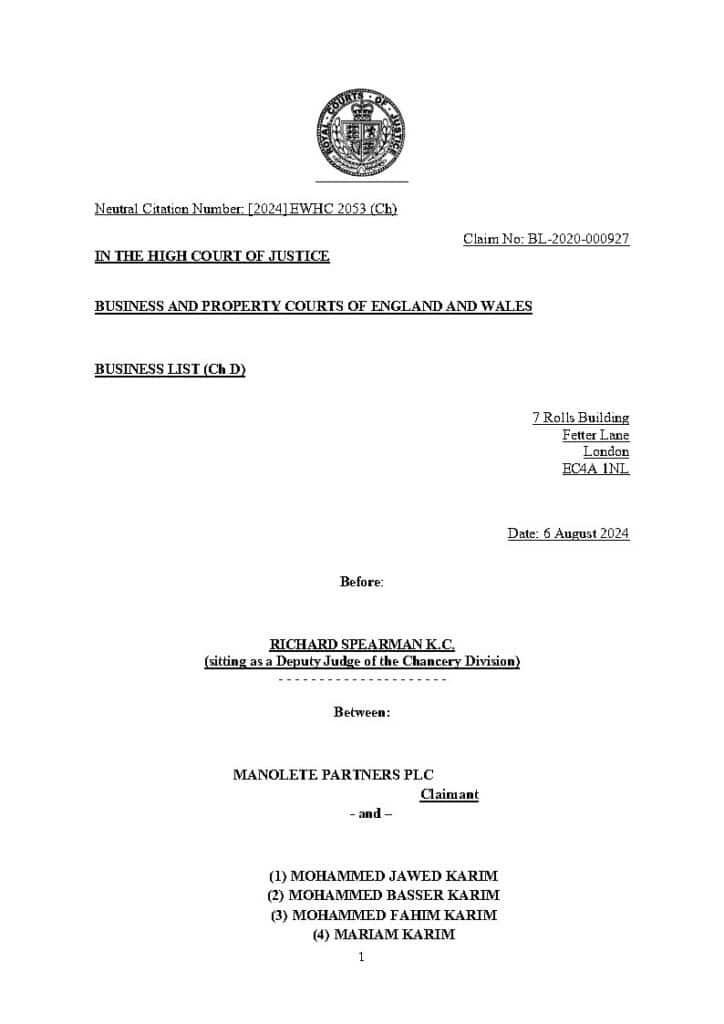
Read the Full Judgment Below:
Key Transactions Impugned
| Category | Amount | Beneficiaries / Purpose | Court Finding |
| African mining ventures | US$1.45m + £34,661 | Personal investments in GEM Global Ventures and Pinnacle Ventures | Misappropriation of company funds |
| Credit card & cash withdrawals | £1.09m approx. | Personal and family use | Unexplained, not for company purpose |
| Unlawful dividends (2014–15) | £267,500 | Paid to directors | In breach of Part 23, Companies Act 2006 |
| Payments to relatives | $381,000 (sister), $129,000 (cousin), £75,000 (associate) | Connected parties | Improper and unrecoverable |
| Property transfer via Mariam Karim | £250,000 | Used for joint property purchase | Traceable and recoverable |
By 2015, the company’s audited accounts were found to be materially inaccurate, containing fictitious debts and assets that concealed underlying insolvency (paras 49–58).
Key Findings in Manolete Partners plc v Karim
Breach of Director Duties (Paras 23–33)
Spearman KC held that the directors breached their fiduciary and statutory duties under sections 171–174 of the Companies Act 2006. They failed to act for proper purposes, disregarded creditor interests once insolvency was probable, and allowed the company to make unlawful distributions. The court adopted the reasoning in Re HCL Environmental Projects Ltd [2014] BCC 337 and Sequana to find that directors’ duties shift towards creditors when insolvency is foreseeable.
“They treated the Company as if it was a bank, and its assets as if they belonged to them.” (para 3)
The judge agreed with Manolete’s submission that the directors’ actions were “wholly inconsistent with the promotion of the success of the Company” and instead constituted “defalcations from the Company’s monies for personal benefit.”
Unlawful Dividends and Improper Accounting (Paras 38–43)
The company declared dividends of £267,500 between 2014 and 2015 when its accounts failed to give a true and fair view. Applying Bairstow v Queens Moat Houses plc [2002] BCC 91, the Court held the distributions were ultra vires and unlawful. Spearman KC reaffirmed that directors and shareholder recipients who “know or ought to have known” the factual unlawfulness of a dividend must repay it (para 43).
Misuse of Company Funds (Paras 75–104)
The Court found substantial misapplications of company property, including personal tax payments, cash withdrawals, and speculative overseas investments. The most egregious examples were the payments of over US$1.4 million for “African mining ventures” and US$54,000 to a US law firm representing a separate entity, ATISL, controlled by Jawed Karim.
“There is no documentary evidence to support a suggestion that these payments were made in connection with the Company’s business… the Company did not receive any benefit.” (para 79)
Failure to Exercise Reasonable Care and Skill (Paras 35–37)
The directors were criticised for failing to maintain management accounts or cash flow forecasts, ignoring clear signs of creditor distress, and relying on misleading accounts. The judge found that by 2014, Evershine Travel was unable to pay its debts as they fell due (paras 67–73).
“It seemed counterintuitive that a company that managed to stave off cash-flow insolvency by going deeper and deeper into long-term debt was not insolvent.” (para 73, citing Bucci v Carman [2014] BCC 269)
Implications of the Karim Judgment
This decision underscores that courts will take a strict view of directors’ conduct once insolvency risk arises. As with Sequana, the duty to act in the interests of creditors becomes paramount when a company is insolvent or on the verge of insolvency. Expert legal advice is crucial to understand the duties owed by directors once insolvency looms.
The ruling also confirms that litigation funders such as Manolete Partners can successfully pursue complex post-liquidation claims. For directors, this signals the importance of contemporaneous record keeping and prompt insolvency advice by experts. As seen in numerous examples, directors remain fiduciaries even in family companies and cannot excuse mismanagement by delegating responsibility.
In practical terms, this case aligns with a growing trend of insolvency litigation targeting directors years after liquidation, often backed by litigation funding. For professional advisers, it also highlights the value of early engagement with experienced winding-up petition solicitors or restructuring experts when creditor pressure intensifies.
Defending Manolete Director Claims
Defending a Manolete-funded action requires early forensic analysis and evidential control. LEXLAW’s insolvency team regularly advises directors facing claims for breach of duty, unlawful dividends, or transactions at undervalue. Establishing a defence often depends on reconstructing financial data, tracing the commercial rationale for payments, and challenging the liquidator’s expert evidence.
Directors should engage expert solicitors and commission forensic accounting reports to challenge assertions of undervalue or insolvency timing. Establishing contemporaneous board minutes or cash flow forecasts can also rebut allegations of subjective dishonesty. In some cases, negotiated settlements are achievable through structured repayment plans where liability is arguable.
Timely instruction of a specialist Manolete claims defence solicitor is essential to prevent default judgments and to ensure proportionality in any agreed settlement or consent order. Contact Now for Expert Insolvency Legal Assistance!
Check Your Litigation Case ✔
We analyse your case prospects. We deliver strategic legal advice at your first fixed fee meeting. We get optimal legal results. Want our opinion on your case? Click below or call our lawyers in London on ☎ 02071830529
FAQ on Directors’ Duties
Why is this case significant for insolvency law?
It clarifies that directors who divert funds to personal or speculative projects face personal repayment obligations even years after liquidation. The Court’s approach in Karim reinforces that insolvency duties to creditors under Sequana override shareholder interests once financial distress is foreseeable.
What constitutes a breach of directors’ duties in insolvency?
Using company assets for personal benefit, making unlawful dividends, or maintaining inaccurate accounts each amount to breaches of sections 171–174 of the Companies Act 2006. This judgment shows that courts impose strict accountability on directors, especially when family-controlled companies blur the line between personal and corporate assets.
Can Manolete Partners pursue me after company dissolution?
Yes. As the assignee of claims from liquidators, Manolete may issue proceedings even years after dissolution. Directors remain personally liable for misfeasance and unlawful distributions. LexLaw’s Manolete defence guide explains available procedural and limitation defences.
How does this affect litigation funders like Manolete?
Karim demonstrates the effectiveness of litigation funding in pursuing complex multi-director claims where the insolvent estate has no resources. However, funded cases still require strong evidential grounding, and courts may scrutinise proportionality and fairness in costs recovery.
What practical steps should directors take to avoid liability?
Maintain real-time management accounts, ensure dividends comply with Part 23 CA 2006, and seek professional insolvency advice if creditor arrears arise. Early engagement with specialist insolvency dispute solicitors may prevent later personal exposure.
Can shareholders ratify breaches once insolvency occurs?
No. As the judgment and Sequana confirm, once insolvency is probable, creditor interests supersede shareholder control. Any attempt at ratification would be void against the company’s creditors.